
7 Affordable AI Tools to Boost Productivity for Vietnamese SMEs
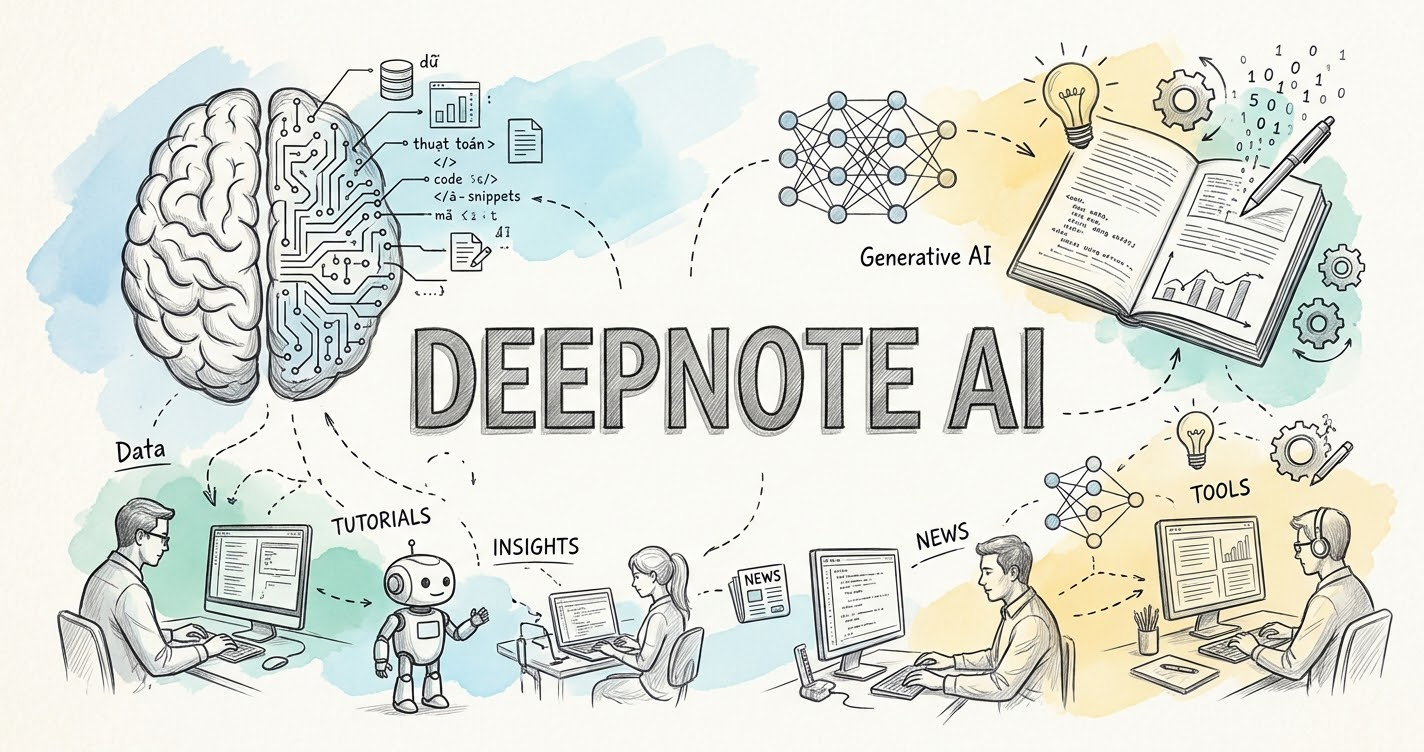
Vietnamese SMEs face a difficult choice: digitize operations to stay competitive or manage tightening budgets. Many owners believe digital transformation requires expensive, rigid enterprise software. This "all-or-nothing" approach often stalls progress and wastes capital.
The most effective path to modernization involves curating high-ROI, affordable AI tools for small business that offer modular, scalable functionality. By selecting the right stack, you can automate labor-intensive tasks and achieve immediate productivity gains without depleting cash reserves.
At Deepnotes, we identify lean, high-impact solutions. This guide highlights the best AI tools for SMEs in the Vietnamese market, focusing on platforms that provide value, ease of integration, and efficiency. You will learn how to build a cost-effective AI solutions for business architecture that empowers your team to do more with less.
Evaluating AI Tool ROI for the Vietnamese Market
The best AI tools for SMEs provide immediate, measurable returns by automating high-frequency, low-complexity tasks. Before committing to any platform, evaluate its ROI through the lens of local operational realities, including language support and integration flexibility.
Establishing Selection Criteria for Local Impact
When assessing affordable AI tools for small business, prioritize the tool's ability to handle Vietnamese language nuances. Many global models struggle with tonal complexities, leading to errors in customer support or content generation. Prioritize platforms that offer robust API access, allowing you to use custom prompts that account for regional business terminology.
Beyond language, favor platforms with a "freemium" or low-cost subscription model. Avoid tools that require heavy upfront licensing fees. Instead, look for solutions that operate on a pay-as-you-go basis via API, ensuring costs remain tethered to your actual production volume.
| Selection Criteria | Priority Level | Rationale for Vietnamese SMEs |
|---|---|---|
| Vietnamese Language Support | Critical | Ensures accuracy in customer-facing interactions. |
| API Accessibility | High | Allows connection to existing CRM/ERP systems. |
| Scalable Pricing | High | Prevents budget bloat during early-stage adoption. |
| Low Barrier to Entry | Medium | Reduces training time and technical overhead. |
Avoiding Shiny Object Syndrome
A common pitfall is "shiny object syndrome"—investing in hyped AI models that offer unnecessary features. To maximize your cost-effective AI solutions for business, start by conducting an AI workflow audit to identify specific operational bottlenecks. If your team spends hours manually transcribing meetings, focus exclusively on tools that solve that problem.
By narrowing your focus, you avoid "feature creep" that leads to wasted subscription costs. If a tool doesn't contribute to time savings or revenue growth within 30 days, it is likely a distraction.
Calculating the True Cost of Automation
To determine if an AI tool is affordable, compare the monthly subscription cost against the value of labor hours saved. If a $30/month subscription automates a task that required 10 hours of manual labor, you pay $3 per hour for that output. If this cost is lower than your staff's hourly rate, the tool provides a positive ROI.
For a broader perspective on how these choices fit into your long-term digital transformation, refer to our AI Transformation for SMEs in Vietnam: A Strategic Guide.
The 7 High-Impact AI Tools for SME Operations
To achieve digital transformation, move beyond standalone chatbots and adopt a stack that functions as a cohesive ecosystem. These seven affordable AI tools for small business are selected for their API-first design and proven utility.
1. Claude 3.5 Sonnet: Analytical Powerhouse
Claude 3.5 Sonnet is the premier choice for complex document analysis and coding support. Its "Artifacts" feature allows you to view and iterate on code or long-form documents in a side-by-side window. For SMEs, this is vital when debugging internal scripts or summarizing dense legal contracts.
2. Perplexity AI: Real-Time Market Intelligence
Perplexity acts as a research assistant, providing cited, real-time data. For Vietnamese SMEs, it is invaluable for competitor intelligence—quickly aggregating market trends, regulatory updates, or consumer sentiment shifts.
3. Make.com: The Orchestration Layer
Make.com is essential for connecting AI agents to your existing CRM or databases. It uses a visual interface to build multi-step workflows—such as routing customer inquiries from Facebook Messenger to your CRM, summarizing them with Claude, and drafting a response.
4. Canva Magic Studio: Rapid Content Localization
Marketing for the Vietnamese market requires high-quality, localized visuals. Canva Magic Studio automates repetitive design tasks, such as resizing assets or generating localized copy. Its "Magic Switch" feature translates and adapts marketing materials instantly.
5. Fireflies.ai: Automated Meeting Intelligence
Fireflies.ai records, transcribes, and summarizes meetings with high accuracy, including support for Vietnamese. Integrating this into your operations ensures that every decision made in a meeting is captured, indexed, and searchable.
6. Notion AI: Centralized Knowledge Management
Notion AI transforms your workspace into a self-organizing repository. You can instantly summarize project notes, generate meeting agendas, or query your internal database to find specific information.
7. Zapier: Cross-Functional Workflow Automation
Zapier is the standard for rapid, no-code integrations. It connects over 6,000 apps, allowing you to trigger actions across your entire tech stack, such as saving email attachments to Google Drive or updating Trello boards.
| Tool | Primary Use Case | Best For |
|---|---|---|
| Claude 3.5 | Complex Analysis | Coding & Strategy |
| Perplexity | Market Research | Competitor Intel |
| Make.com | Workflow Logic | Advanced Automation |
| Canva | Content Creation | Marketing Teams |
| Fireflies | Transcription | Meeting Management |
| Notion AI | Knowledge Base | Internal Operations |
| Zapier | App Connectivity | Cross-Platform Sync |
Integrating AI Tools into Your Existing Tech Stack
Connecting affordable AI tools for small business to your infrastructure is the difference between a novelty experiment and a genuine operational engine.
Orchestrating Workflows via API
The most efficient way to connect tools like Claude or Perplexity to your CRM is through automation platforms like Make.com or Zapier.
Define the Trigger: Identify the event, such as a new lead in your CRM.
Map the Data: Extract specific fields from the trigger.
Send to AI API: Format the data into a prompt and send it to the AI model.
Action the Output: Direct the response back into your workflow, such as drafting a reply.
Data Privacy and Security in Vietnam
Vietnamese SMEs must navigate strict data handling requirements. Prioritize tools that offer enterprise-grade privacy settings, such as opting out of model training for your data. Always redact PII (Personally Identifiable Information) before sending data to an API.
Troubleshooting Integration Failures
If your automation breaks, check the platform’s logs. Common issues include API rate limits (429 errors) or authentication failures (401 errors). For persistent issues, verify that your API keys are active and your JSON formatting is correct.
For a deeper look into the hurdles you might face, review our guide on 5 Common Barriers to AI Adoption for Vietnamese SMEs and How to Overcome Them.
Adopting AI is about identifying friction points and applying targeted, cost-effective AI solutions for business. Start small—by automating a single, repetitive task—and measure the time saved before expanding your stack. The best AI tools for SMEs are those that integrate cleanly into your existing workflows. If you are ready to scale, conduct an AI workflow audit to pinpoint where your team loses the most time.